

Our Housing Studio is passionate about creating respectful, nurturing environments for residents to thrive within a wide variety of project types. When it comes to senior living, we implement forward-thinking design strategies that further emphasize residents’ comfort, dignity, and health. As designers, how do we respond when the challenges of the housing crisis meet the needs of an aging population? How can clients increase the resiliency of their developments in the context of the current population shift and the future demand 30, 40, or 50 years from now? We approach this urgency with a deliberate philosophy to design for a resilient future.
Forging the way, MWA Principal Bill Lanning uses his understanding of housing and senior living to shape our housing studio and guide the industry forward. Below, Bill shares his experience from more than 33 years of dedication to affordable housing projects throughout the West and key insights from our recent senior living projects.

Westlake Christian Terrace West
What are the biggest current challenges with senior living projects?
Funding is the first hurdle, and it’s uneven. As market-rate and non-profit developers pull from entirely different funding streams, no two projects are really developed on the same terms. The developers who move fastest are usually the ones who already own land and are either adding additional homes or undergoing major renovations, which removes one of the biggest barriers before design even begins.
Once an owner knows where they will build, they must then address the size of the new development. Demand for senior housing is currently high and only rising, with a large percentage of this generation of retirees having the savings to support it. The senior tsunami is here: the 75+ population has started to surge and will continue to do so until around 2040, when it begins to plateau relative to the other age demographics. If we design for today’s peak too literally, we risk building something that struggles to stay full for a couple of decades before the next projected incline begins in the 2060s. We face an uncomfortable fact: the lack of overall housing development, due to inflation and interest rates, means the senior living community is projected to need approximately 750,000 new homes by 2030.
Underneath all this sits another growing point of tension: affordability versus programming. Retirement brings free time, and free time creates demand for amenities, which can end up stressing costs across a project. Maintaining affordability in an amenity-rich environment can be a difficult challenge and one that necessitates scrutinizing project priorities more carefully.
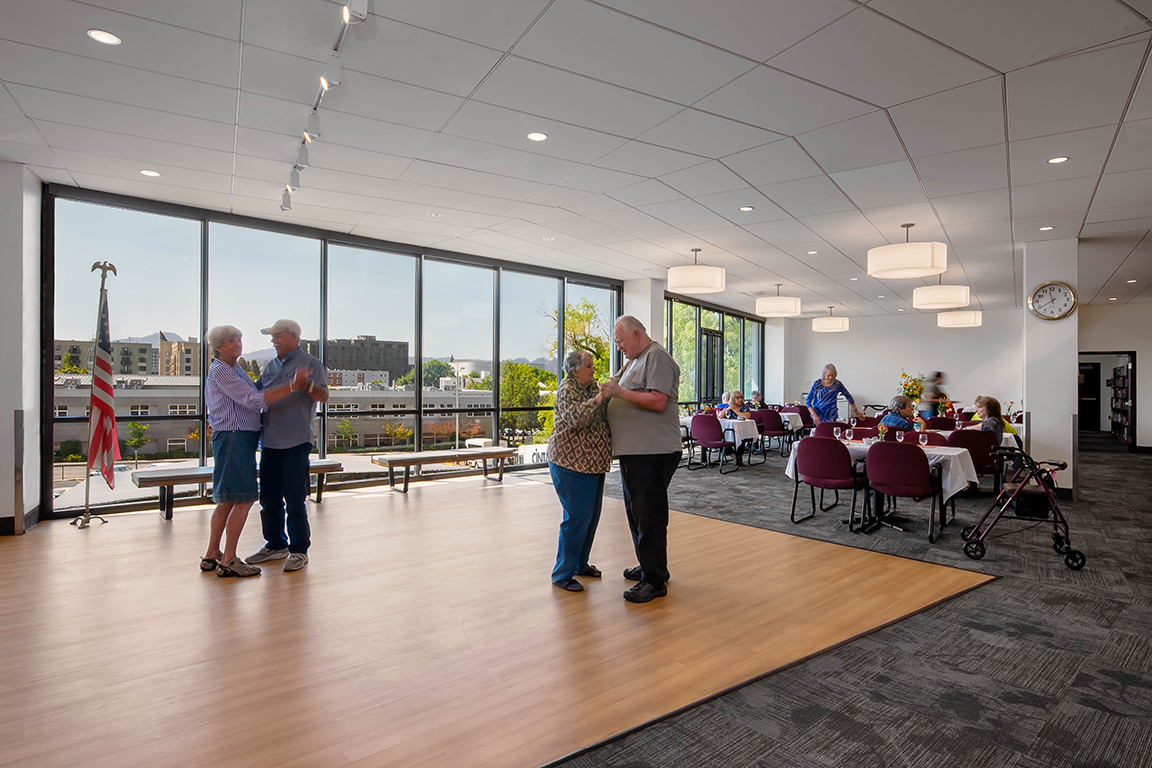
How is senior living changing alongside aging generations and populations?
Senior housing faces the same inherent challenges as any housing project, but its residents represent a unique demographic. While this has always been true for senior housing, it is even more relevant for this current generation of seniors. A meaningful share of today’s seniors came up in a stronger economy than previous generations, and a number of senior developments draw exclusively from that wealth bracket, allowing them to be well-positioned to capture that spending power. Current trends don’t always align with that carrying forward as younger generations haven’t had the same runway to build retirement savings, so the housing itself will need to adapt as its resident base changes.
While a large percentage of high-earning seniors continues to increase, so does the percentage of seniors that have not been as fortunate. As development increases to fill the housing gap, it is important to discuss how we can balance this across all income spectrums. The senior living development trend has shifted from three hard categories — independent, assisted living or memory care, skilled nursing — to a more gradient continuum of care. The ability to maintain this model is being stretched with a continuing reduction in the necessary senior based and health care services within the larger community in locations outside of major urban centers. This factor, along with limited land availability on existing campuses, is opening the window for new approaches to senior housing, such as the hub-and-spoke model, where independent senior living is located remotely from the main campus. This gives residents more independence while still providing them with the baseline services they need.

Westlake Christian Terrace East
How have renovations played a role in senior living?
Change is hard, and it doesn’t get easier as we age, which is why stability is even more integral to senior housing. Aging in place protects routines, preserves relationships, and avoids the disruption of relocating, which can be tangibly detrimental to our quality of life. Because of this, we often see recent retirees who move into a new development tend to stay there for much longer than other demographics. The lack of turnover means the median age of residents steadily trends upwards. While most housing has cyclical communities that rebalance and generally maintain the same median age, senior housing populations can outgrow rigid spaces. Renovations extend a building’s usable life, improve accessibility, and accommodate other needs as we age. They bring current technology and spatial relationships into a building meant for an ever-evolving community. Today’s seniors are different from previous generations: they are often well-traveled, affluent, and simply expect more from where they live. Meeting these expectations means we must preserve an existing building while updating it to accommodate these needs. The question is: how can we build in the resiliency needed to keep it adaptable for future generations?
The same can be said for how owners think years down the line. We expect senior housing demand to soften eventually, so some owners are already planning, if not actively pursuing, renovations that would convert these properties into unspecialized or intergenerational housing once that demand shift arrives. The population trajectory prioritizes flexibility, so developers can either front-load that into newly constructed projects or pursue renovations as needs arise.
How might the necessities of senior living shape communities?
A few forces are pulling in the same direction: the ongoing need for affordable housing, a continuum-of-care model that’s identifying more residents with lighter-touch needs, and a demand curve that will dip and then rapidly rise again. Together, they make a strong case for intergenerational living, with seniors staying closer to family instead of moving into isolated, single-purpose developments. The hub-and-spoke model, which disperses homes throughout a community rather than concentrating them in one self-contained complex, may be a great model for this consideration.
That integration also cuts both ways. Today’s seniors can afford more amenities and a higher standard of living, and when those amenities are incorporated into an intergenerational setting, it raises the quality of the whole community.
What lessons are currently being learned across senior living projects?
While overall housing development has lagged, I believe that developers are trying to maintain communities by balancing building for today’s demand and preparing for the plateau that follows. We should build structures that last for at least a century in an industry that is continually shifting. The decisions that are being made now need to be foundational enough to withstand industry changes over time. To achieve this necessary resilience, owners, designers, and contractors will need to combine their collective development experience.

Broadleaf Arbor Affordable Apartments
Another clear lesson is that aging isn’t uniform and individual needs can vary enormously from one resident to the next. I’ve come to see that as an opportunity rather than a complication. The projects that succeed have enough built-in flexibility to meet residents where they currently are, and might be in the future, instead of forcing everyone into a single mold. The senior living industry is under a lot of pressure right now. From the slowdown in development to staffing shortages at all levels, the increasing demand can be daunting. While I believe that technology advancements will continue to have a role in solving some of these challenges, we are still a community of people. Designers need to talk with staff to understand their jobs so that we can develop built environments that provide the support, relief, and comfort they need.
Senior living is changing and will continue to face new challenges in the future. It is crucial to recognize these upcoming challenges and address them proactively, both for senior well-being and long-term stewardship of these communities.